

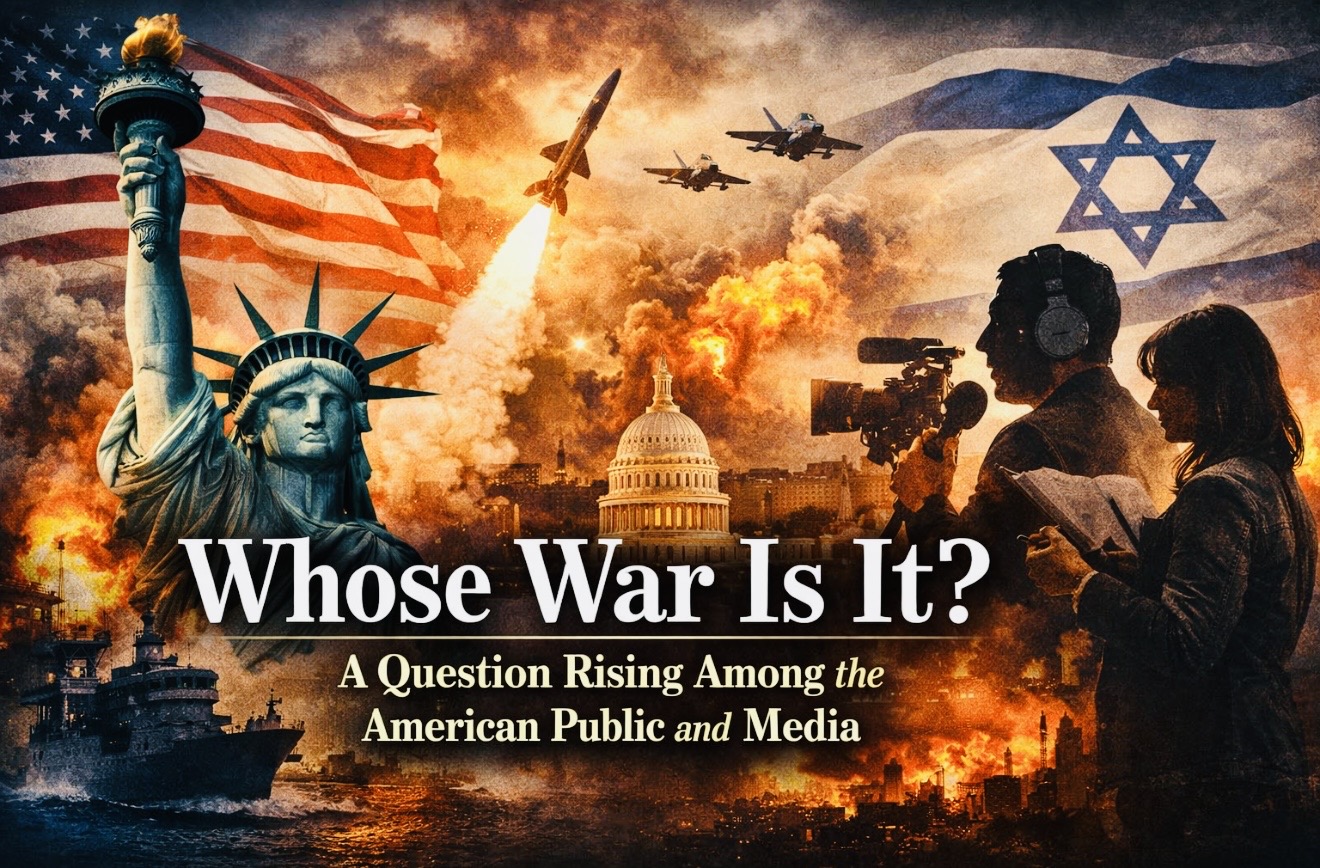
Whose War Is This? A Question Echoing Across America
By Raja Zahid Akhtar Khanzada
In the unsettled winds of March, the sounds traveling between Tehran and Tel Aviv are no longer merely the thunder of missiles or the distant rumble of naval fleets.
War has changed its vocabulary.
It is no longer fought only with tanks, rockets, and fighter jets. Words themselves have begun to function as ammunition. Narratives move through the public sphere like invisible projectiles. Newsrooms, television studios, and digital platforms have become battlegrounds where truth and interpretation collide.
In this moment, war is not only being waged on land and sea. It is being fought over the very definition of reality.
For generations, the United States cultivated an image of itself as a republic where even the most powerful leader ultimately stopped at the threshold of the Constitution. It was a country where journalism served not merely as a profession but as a mirror, reflecting the state back to itself, forcing it to confront its own reflection.
But the conflict surrounding Iran has unsettled that mirror.
There is now a strange unease in the American conversation, as though a powerful nation has suddenly become uncomfortable with what it sees in its own reflection.
Perhaps for the first time in years, the question is being asked openly inside the United States: Is this truly America’s war?
Some critics argue that the confrontation with Iran is not fundamentally an American conflict at all, but rather an Israeli one into which Washington has gradually been pulled.
In their view, the slogan of “America First,” once central to American political rhetoric, now appears to have quietly faded from the foreground of foreign policy. In its place, they suggest, an uncomfortable perception is emerging that strategic priorities have shifted toward something closer to “Israel First.”
From Tehran, the counterargument arrives with equal clarity.
Iranian officials insist that the United States speaks the language of diplomacy while continuing military pressure at the same time. They argue that history is full of such moments when negotiations and bombardment proceed side by side, each advancing under the shadow of the other.
Tehran maintains that it is not at war with the American people. Iranian leaders frame the confrontation as an act of national defense, insisting that they have neither the intention nor the ability to retreat from that position.
Amid the noise of accusations and the relentless echo of war, another voice has entered the American debate: Tucker Carlson.
In a video statement that quickly stirred discussion in Washington, Carlson claimed that Israel had come under intense pressure in the conflict and warned that if the escalation continued, Tel Aviv might eventually confront the terrifying question of whether nuclear weapons should be considered against Iran.
It was a statement that did more than describe a military possibility.
It invoked one of humanity’s oldest and darkest fears.
A nuclear war is not merely an explosion. It is the death of fertile land, the birth of radioactive skies, and the inheritance of suffering passed from one generation to the next. Radiation does not recognize borders. Carried by wind, it travels from city to city, from nation to nation, settling quietly into human lungs, skin, blood, and bone.
Even the thought of such a scenario sends a tremor through the memory of human civilization.
Yet the shockwaves of this conflict are not limited to military calculations. They are reshaping the intellectual and journalistic landscape of the United States itself.
What is striking about the current debate is that dissent is emerging from across the ideological spectrum.
Some of it comes from liberal commentators. Some from voices traditionally aligned with conservative politics or even sympathetic to former President Donald Trump.
Together they converge around a single question:
Is the United States entering another war that it neither needs nor fully understands?
Carlson argues that Washington is once again being drawn toward a Middle Eastern conflict whose consequences could extend far beyond the region.
Megyn Kelly, once a prominent anchor at Fox News and NBC, has raised a blunt question of her own: whether it is wise to place American soldiers in danger for the strategic interests of another nation.
Conservative commentator Matt Walsh has also challenged the justification for the war.
Investigative journalist Glenn Greenwald has warned that wartime is precisely the moment when governments attempt to shape and control information, making such periods a defining test for the integrity of journalism.
Meanwhile, British American journalist Mehdi Hasan has repeatedly pointed to what he describes as double standards in Western media coverage of conflicts in the Middle East.
Other prominent figures have joined the conversation.
Chris Hayes of MSNBC has characterized the confrontation as a geopolitical struggle capable of pulling the United States into yet another costly entanglement.
Fareed Zakaria, the global affairs analyst at CNN, warns that a direct war with Iran could disrupt the delicate balance among major global powers.
Rachel Maddow argues that attempts to intimidate or silence journalists during wartime represent a threat not merely to the press but to democracy itself.
Anderson Cooper continues to report on the human consequences unfolding across the region.
Thomas L. Friedman, writing in The New York Times, has cautioned that a new Middle Eastern war could shake the foundations of the global order.
Despite their many disagreements, these voices converge around one haunting question.
In the noise of war, what exactly is America fighting for?
CNN recently published an analysis titled “Seven Reasons Why Trump Hasn’t Won the Iran War.” The report highlighted several troubling realities.
The expectation of a swift victory has proven unrealistic. Washington had hoped that Iran’s leadership might quickly weaken, but that has not happened.
The Strait of Hormuz, one of the world’s most critical energy corridors, has become a source of global anxiety. If that waterway destabilizes, claims of victory begin to lose their meaning.
Iran’s leadership remains intact.
Strategic differences between Washington and Tel Aviv have begun to surface.
Global oil prices have surged.
Iran’s nuclear infrastructure has not been completely dismantled.
And perhaps most significantly, there is still no clear narrative of victory. The United States government has struggled to explain to the American public what winning this war would actually look like.
Meanwhile, the global economy trembles under the weight of uncertainty.
Oil prices continue to rise. Stock markets have shed trillions of dollars in value.
American forces stationed across the Middle East face growing risks. U.S. companies have reportedly become potential targets. Wealthy Arab investors who have placed hundreds of billions of dollars into American markets are quietly questioning why such a conflict began without consultation, placing both their investments and regional stability in jeopardy.
Iran has also hinted that future oil transactions could be conducted in the Chinese currency, the yuan, rather than the U.S. dollar.
If such a shift were ever to occur on a significant scale, it could deliver a profound shock to the architecture of the global financial system.
At the same time, analysts note that America’s strategic oil reserves are approaching some of their lowest levels in decades, even though the war itself is still in its early days.
Inside Washington, tensions between government and media have also begun to rise.
The Trump administration has warned news organizations that their broadcast licenses could be suspended if they disseminate what officials describe as false information about the war. The defense secretary has publicly criticized several television networks.
Meanwhile, the United States has appealed to allies for naval support.
The responses have been cautious.
China has called for a cease-fire. France has declined participation. Japan has remained largely silent. South Korea has made no firm commitment.
And Switzerland, citing its historic neutrality laws, has reportedly refused to allow American military aircraft to pass through its airspace.
All of this suggests that the conflict is being fought not only on the battlefield but also in the quiet corridors of diplomatic isolation.
History teaches a simple truth: wars are not won by weapons alone.
They are won by economic resilience, by diplomatic alliances, by narratives that persuade both the world and a nation’s own citizens.
But when citizens begin asking questions about a war their government is fighting, when television studios, university classrooms, and legislative halls all echo with the same uncertainty, when the public begins to ask not only how a war will be fought but why it began at all, then the conflict has already moved beyond borders.
At that moment, war ceases to be merely a contest over territory.
It becomes a crisis of identity.
Perhaps that is the moment the United States now faces.
The confrontation with Iran has reached a point where declarations of victory grow faint and the road ahead dissolves into fog. A moment when moving forward becomes dangerous, yet retreating no longer appears simple.
There is an old Urdu proverb.
It speaks of a snake that has seized a shrew in its mouth, only to discover that it can neither swallow it nor spit it out.
History occasionally produces such moments.
Moments when even powerful nations quietly discover that wars, once begun, have a way of trapping their creators.
And so the question continues to echo across the American landscape:
Whose war is this?
Known for his forthright journalism and incisive analysis, Khanzada has written extensively on geopolitics, diplomacy, human rights, and the concerns of overseas Pakistanis. This article has been specially translated into Spanish from his original Urdu column.
