

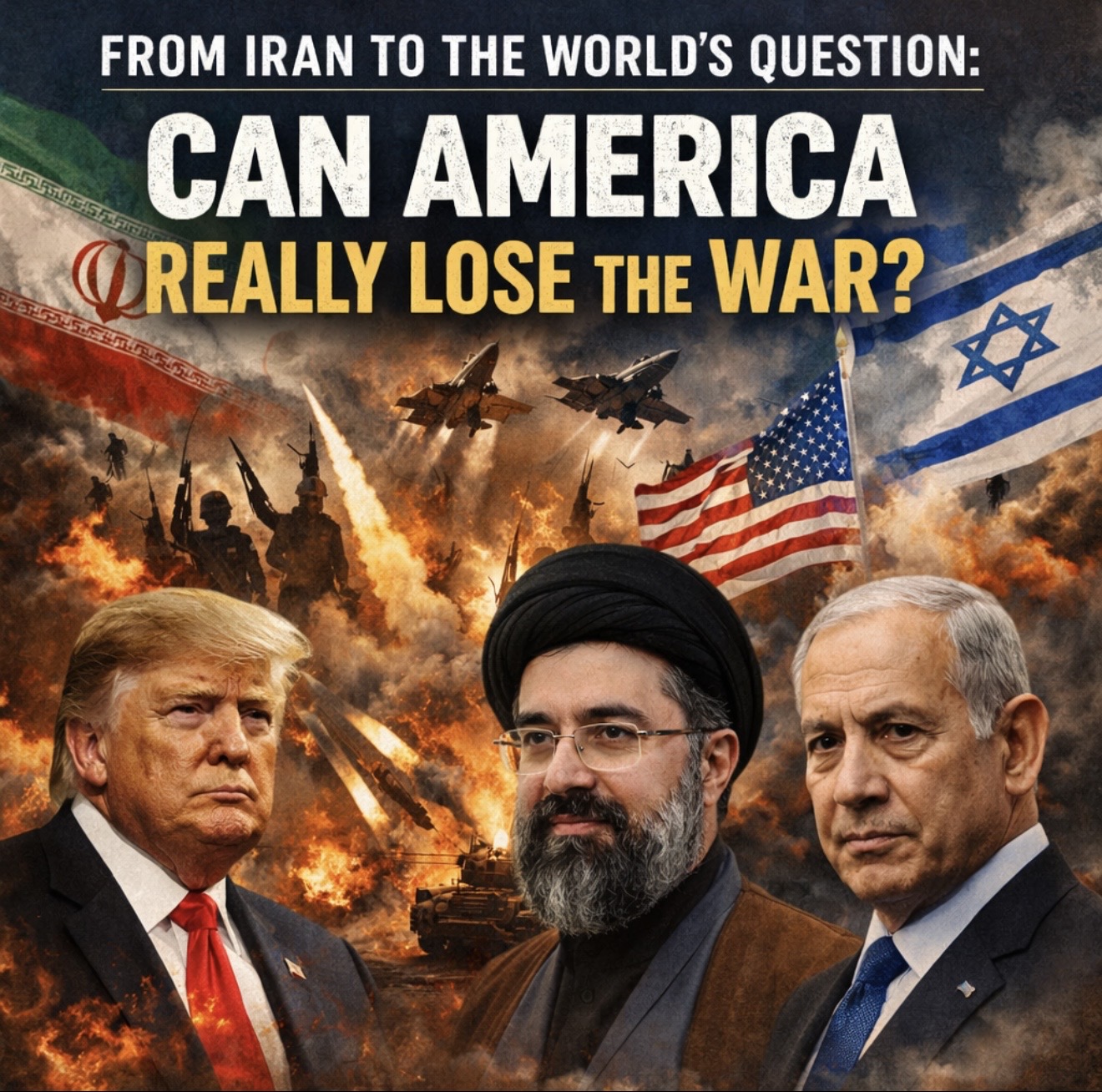
Iran War Raises a Global Question: Could the United States Actually Lose?
By Raja Zahid Akhtar Khanzada
The Middle East may be the only place on earth where history is not merely written in books but echoed through grains of desert sand, oil fields, sacred sites and the thunder of missiles. Here wars rarely begin as purely military calculations. They grow from centuries old narratives of faith, power, identity and geopolitical ambition. The joint war waged by the United States and Israel against Iran appears to be the newest chapter in that long unfolding story.
This conflict did not erupt overnight. Behind it lie years of escalating tensions, failed diplomacy, covert operations, economic sanctions and shifting regional alliances. Yet when war finally begins, the question is never simply who fired the first missile. The deeper question becomes who wanted this war, why it was pursued, and who ultimately stands to win.
It was precisely these questions that framed a recent discussion with geopolitical analyst Professor Xueqin Jiang, host of the widely followed YouTube channel Predictive History. Jiang has built a reputation for applying game theory and historical patterns to the study of global politics. For years he has examined international conflicts through the lens of long term strategic behavior rather than immediate events.
Professor Jiang is known for unconventional analyses of global power dynamics, American foreign policy, Middle Eastern politics and the emerging world order. Long before the current escalation, he made a striking set of predictions that have since resurfaced in policy discussions and media debates.
In a lecture delivered in 2024, Jiang outlined three bold forecasts. First, he predicted that Donald Trump would win the presidential election and return to power. Second, he said the United States would eventually enter into direct conflict with Iran. Third, and most controversially, he argued that the United States might ultimately fail to achieve victory in such a war, an outcome that could reshape the global balance of power.
Today, as hostilities between Washington, Tel Aviv and Tehran intensify, Jiang’s predictions are being revisited with renewed attention. According to his analysis, the current conflict is not a conventional war but what strategists describe as a war of attrition. In such conflicts, victory does not come from rapid military triumph but from the gradual exhaustion of the opponent’s political, economic and logistical capacity.
Iran, Jiang argues, has been preparing for precisely such a scenario for nearly two decades. In the ideological language of Tehran’s leadership, the United States has long been described as the “Great Satan,” a framing that has shaped Iran’s defense doctrine and regional strategy. Over time this perception has driven the creation of a network of alliances and proxy forces designed to offset conventional military disadvantage.
According to Jiang, Iran’s greatest strategic asset is not its conventional military strength but its regional network. Groups such as the Houthis in Yemen, Hezbollah in Lebanon, Hamas in Gaza and various Shia militias operating in Iraq and Syria form an informal strategic axis. These organizations provide Iran with the ability to open multiple fronts simultaneously without engaging in direct state to state warfare.
In Jiang’s view, these actors have spent years studying American military behavior and strategic culture. Their aim is not to defeat the United States in a traditional battlefield confrontation but to stretch its resources across multiple theaters, gradually weakening its ability to sustain prolonged operations.
More significantly, Jiang argues that Iran’s strategy extends beyond the battlefield. It is designed to target the infrastructure that sustains the global economy. At the center of this strategy lies the Strait of Hormuz, one of the world’s most critical maritime chokepoints through which a significant portion of global oil supply passes.
If the strait becomes unstable or effectively blocked, the consequences would ripple across global energy markets. But Jiang suggests the implications go further. Nearly ninety percent of the Gulf region’s food imports travel through these same maritime routes. Any prolonged disruption could therefore threaten not only energy prices but the stability of regional supply chains.
Another vulnerability, often overlooked in strategic discussions, is water. Much of the Gulf region depends on desalination plants that convert seawater into drinking water. These facilities form the backbone of urban life across Saudi Arabia, the United Arab Emirates, Bahrain and Qatar. According to Jiang, the destruction of a single large desalination facility serving a major city could create a severe humanitarian crisis within weeks.
Such vulnerabilities illustrate how modern warfare increasingly blurs the line between military and civilian infrastructure. The battlefield now includes energy pipelines, shipping lanes, water systems and digital networks.
Jiang also highlights the role Gulf states play in sustaining the global financial system. These countries sit at the center of the petrodollar framework that underpins much of the international economy. Any disruption to that system could have far reaching consequences for the global reserve currency structure dominated by the U.S. dollar.
During the interview, hosts referenced footage showing multiple interceptor missiles launched to destroy a single incoming Iranian ballistic missile, many of which failed to intercept their target. The incident raised questions about whether the United States can sustain the enormous financial cost of modern missile defense if the conflict continues.
Jiang believes this asymmetry represents a structural challenge for the American military. Much of the U.S. defense system was built during the Cold War, when technological superiority and highly sophisticated weapons were seen as the key to dominance. Yet twenty first century warfare increasingly relies on low cost technologies such as drones and inexpensive missile systems capable of overwhelming expensive defense networks.
In such circumstances, a fifty thousand dollar drone may require millions of dollars in defensive systems to intercept. Over time this cost imbalance becomes difficult to sustain.
For Jiang, this dynamic signals something deeper than a single regional war. It may mark the gradual erosion of the aura of invincibility that has surrounded American military power since the end of the Cold War. If prolonged conflict exposes structural weaknesses in the system, the global order itself could begin shifting toward a more multipolar balance.
Another question raised during the conversation concerned the decision to enter the war despite reservations reportedly expressed by senior American military officials. Jiang outlined three possible explanations.
The first is what he calls imperial overconfidence. Throughout history, powerful states have often entered wars believing their superiority guaranteed victory. From Napoleon’s invasion of Russia to Hitler’s campaign against the Soviet Union, history offers many examples of strategic hubris leading to catastrophic outcomes.
The second factor lies in domestic political calculations. In democratic systems, foreign policy decisions can sometimes intersect with electoral strategy and internal power dynamics. Jiang noted that financial and political support from regional allies may influence decision making in Washington.
He also suggested that prolonged wartime conditions could expand presidential powers, potentially strengthening political authority during periods of national mobilization. In such circumstances, emergency wartime authority might even reshape domestic political timelines, including election dynamics.
The third factor Jiang discussed was ideological. In recent months, a number of American political figures have framed the conflict in explicitly religious terms. Senator Lindsey Graham publicly described the confrontation as a civilizational struggle. Some evangelical leaders close to the White House have invoked biblical language in their rhetoric surrounding the war.
In these narratives, the conflict is sometimes interpreted through religious prophecy or spiritual warfare. Religious advisers associated with the administration have openly prayed for victory and framed the conflict as part of a broader spiritual struggle.
When war becomes infused with sacred language, compromise becomes more difficult. The adversary is no longer merely a geopolitical rival but an existential enemy tied to identity and belief.
The war with Iran therefore raises questions that extend beyond military strategy. It touches on history, ideology, economics and the evolving architecture of global power.
From a purely military standpoint, the United States and Israel possess overwhelming technological superiority. Yet wars are rarely decided by technology alone. Geography, endurance, economic resilience and ideological motivation often shape outcomes over time.
In my view, the central question in this war is not which country appears stronger on paper. The deeper question is which side history ultimately stands with. Powerful nations often believe they can launch wars and then write the narrative of history in their own favor. Yet history rarely belongs to power alone. More often, it is shaped by the endurance of societies, by resistance, and by the long arc of time that tests the will of nations.
In that context, remarks by President Donald Trump have introduced a new layer of debate into the global conversation. Trump has said that Iran must surrender, and has even suggested that decisions regarding Iran’s future leadership could be shaped from outside. Meanwhile, Israeli Prime Minister Benjamin Netanyahu has declared that Israel has all options on the table. These statements carry more than political weight. They echo the language of power that has, at various moments in history, preceded some of the most consequential decisions ever taken by states.
They also raise a deeply unsettling question. If this war intensifies and stretches into a prolonged conflict, could the world approach a moment reminiscent of the closing chapter of World War II in Japan? At that time, the United States demanded Japan’s unconditional surrender. When that did not immediately occur, atomic bombs were dropped on Hiroshima and Nagasaki. Today, as the word “surrender” once again enters the strategic vocabulary surrounding Iran, some observers quietly wonder whether the world is again drifting toward a dangerous historical crossroads.
At the same time, developments inside Iran carry their own implications. Signals emerging from Tehran, including the possible elevation of a new leadership circle connected to the family of Supreme Leader Ayatollah Ali Khamenei, suggest that the Iranian system is preparing for continuity rather than capitulation. If that assessment holds true, the conflict may evolve beyond a contest of missiles and air power. It may become a longer struggle defined by ideology, endurance and national resolve.
In the short term, the United States and Israel may well maintain clear military advantages. Their technological capabilities and global alliances remain formidable. But wars are not always decided in their opening phases. If the conflict expands or drags on, the costs could extend far beyond the immediate battlefield. Energy markets could be shaken, global economic stability could falter, and the political architecture of the Middle East might undergo profound change.
Years from now, historians may look back on this moment not simply as a military confrontation with Iran, but as a turning point in the evolution of global power. It could be remembered as a period when established powers struggled to preserve their dominance even as new geopolitical realities quietly began to take shape.
In the end, wars are rarely decided by force alone. They unfold through time, through political endurance and through the unpredictable movements of history itself. And it is often history — not armies — that delivers the final verdict.
Known for his forthright journalism and incisive analysis, Khanzada has written extensively on geopolitics, diplomacy, human rights, and the concerns of overseas Pakistanis. This article has been specially translated into Spanish from his original Urdu column.
