

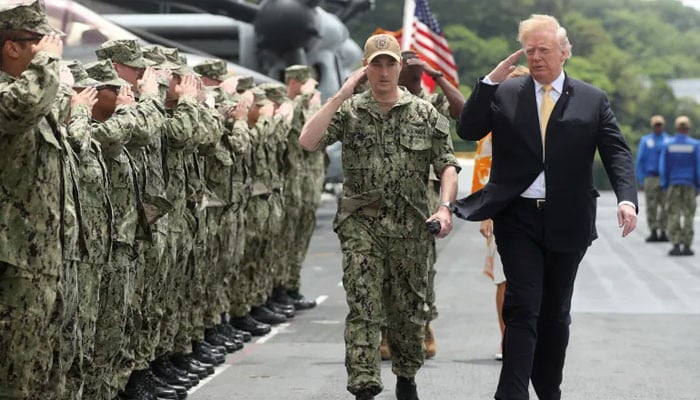
The ongoing conflict between the United States and Iran has reached a critical point, with both sides engaging in a series of escalatory measures. In a recent press conference in Washington, US President Donald Trump stated that the US is not currently deploying ground troops to Iran, but warned that any such move would be a loss of time. He also emphasized that the US would not accept a new Iranian leader who continues the policies of the previous Supreme Leader, Ayatollah Ali Khamenei.
Trump also made statements about Iran’s military capabilities, saying that the country had lost everything, including its navy, and that the US had taken advantage of this weakness. Additionally, he dismissed the claims made by Iranian Foreign Minister Mohammad Javad Zarif that Iran was prepared to launch a land-based attack.
Meanwhile, Indonesian President Joko Widodo warned that his country would withdraw from the US-established Middle East peace process if it did not benefit the Palestinians. The conflict has also had a significant impact on the global economy, with oil prices reaching new highs due to the disruption of oil supplies in the region.
In a separate development, the Israeli military announced that it had struck a three-story building in the al-Aqaba neighborhood of Beirut, which was said to be the home of a retired Lebanese army officer. The building was completely destroyed in the attack.
Iran has also claimed that it had targeted the Israeli embassy in Manama, Bahrain. In Kuwait, a fire broke out at a US military base following an attack. The global oil market has been severely affected by the conflict, with prices reaching a record high of 9 percent.
The Israeli military has also announced that it had struck a senior Iranian commander in Tehran. The conflict has had a significant impact on the budgets and economies of the Gulf countries, with Saudi Arabia, the United Arab Emirates, Kuwait, and Qatar among the countries that could potentially withdraw their investments in the US.
Russia has provided Iran with information on the positions of US warships and aircraft, with 112 drones identified, 109 shot down, and three confirmed to have crashed on the UAE territory. Israel has announced that it would resume flights for foreign nationals starting March 19.
In a surprise development, the Texas primary elections in the US have sparked a new wave of speculation about the future of the state’s politics. The high voter turnout and unexpected results have led some to wonder if Texas could potentially become a competitive state or even a Democratic stronghold in the future.
Reports have also emerged that the son of Israeli Finance Minister Bezalel Smotrich was wounded in clashes with Lebanese forces near the border. The Iranian Revolutionary Guard Corps (IRGC) has claimed that it had launched a new wave of attacks on US and Israeli targets using advanced ballistic missiles.
The speaker of the Iranian parliament, Dr. Mohammad Bagher Qalibaf, has also claimed that the US aircraft carrier Abraham Lincoln had retreated from the battlefield. The IRGC has also claimed that it had shot down an Israeli drone in the city of Isfahan.
In a tweet, Iranian President Hassan Rouhani said that some countries had begun to make efforts to mediate in the conflict. The conflict has also had a significant impact on the global economy, with oil prices reaching new highs due to the disruption of oil supplies in the region.
The British government has offered to pay £1 million to 150 families to leave the country voluntarily, sparking criticism and allegations of racism against the UK’s Home Secretary, Suella Braverman.
