

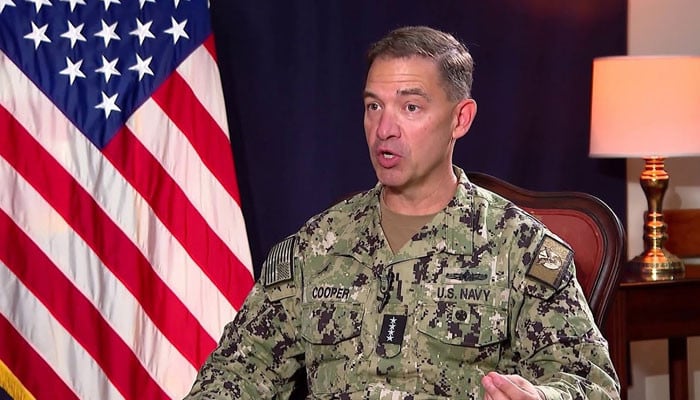
The United States has made a claim that it has attacked over 200 Iranian targets in a 72-hour operation, with more than 30 Iranian ships allegedly sunk. According to the briefing by the US Central Command, Commander Admiral Brad Cooper stated that US aircraft had launched devastating strikes on Iranian missile installations earlier. He claimed that the attacks had resulted in a 90% decrease in Iran’s ballistic missile attacks and an 83% decrease in drone attacks, with the aim of eventually crippling Iran’s missile production capabilities.
Admiral Cooper stated that the US bombing force had targeted approximately 200 targets within Iran, including Tehran, over the past 72 hours. In the last hour, US B-2 bombers allegedly dropped 2,000-pound penetrator bombs on deeply buried ballistic missile launchers. The US Central Command commander claimed that more than 30 Iranian ships have been sunk, with attention to be focused on destroying Iran’s missile production capabilities in the next phase of the operation.
The operation aims to limit Iran’s military and defensive capabilities, with the goal of reducing potential threats in the future. According to Donald Trump, the US had no other option but to launch attacks on Iran, with the aim of destroying its missile and drone capabilities. US Defense Secretary Pete Hegseth stated that the US had not yet started a war, but if Iran believed that the US could not sustain a war, it was mistaken.
The US Defense Secretary added that the US had a war chest full of military equipment and that it would decide the timeline of the war, which could last anywhere from four to eight weeks or more. The US Defense Secretary refused to provide clear information on the targets in Iran.
Meanwhile, Iran has claimed to have attacked the Israeli embassy in Manama, Bahrain, and a fire broke out at a US military base in Kuwait. The global market saw a significant increase in crude oil prices, with a 9% surge following the US failure to open the Strait of Hormuz. The Israeli military stated that a senior Iranian commander was targeted in an airstrike in Tehran.
The ongoing conflict has put pressure on the budgets and economies of Gulf countries, with Saudi Arabia, the United Arab Emirates, Kuwait, and Qatar among those who may have to renege on their multi-billion-dollar investment promises in the US. Russia has reportedly provided Iran with information on the positions of US warships and aircraft, with reports indicating that 112 drones were detected, 109 of which were shot down in the air, and three of which crashed in the United Arab Emirates.
Israel announced that it would resume flights for foreign nationals from March 19. In a surprising turn of events, the US state of Texas saw a record voter turnout in its primary elections, with some analysts speculating that the state may become a competitive battleground between Republicans and Democrats in the future.
Reports also indicate that Israeli Finance Minister Bazel Smotrich’s son was injured in fighting near the Lebanese border. The Iranian Revolutionary Guard Corps claimed to have launched new ballistic missile attacks on US and Israeli installations. Iranian Parliament Speaker Dr. Mohammad Bagher Qalibaf stated that the US aircraft carrier Abraham Lincoln had retreated from the battlefield.
Iranian President Hassan Rouhani announced on social media that some countries had started efforts to mediate the conflict. The global market saw a significant increase in crude oil prices following the US failure to open the Strait of Hormuz. The Kuwait International Airport has resumed flights from March 19. The UK has offered to pay £10,000 to 150 families to leave the country voluntarily, sparking criticism and allegations of exploiting British taxpayers.
The UK’s decision to offer large sums of money to encourage families to leave the country has raised eyebrows, with critics accusing the government of exploiting British taxpayers.
