

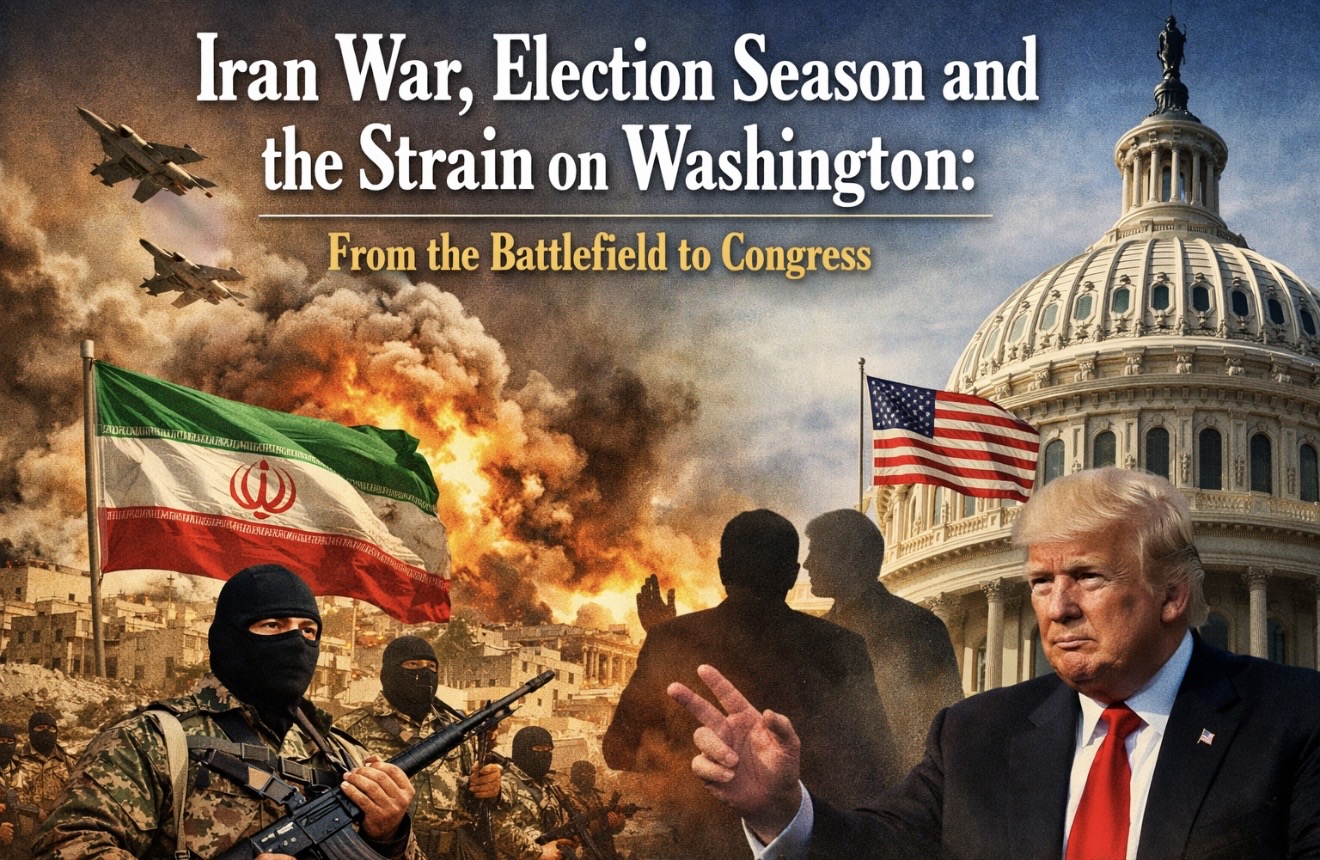
Iran War, Election Season and the Strain on Washington: From the Battlefield to Congress
By Raja Zahid Akhtar Khanzada
What began as a large scale military operation against Iran has quickly evolved into a confrontation with implications far beyond the initial airstrikes. The effects are visible not only across the Middle East but also inside the American political system, where questions of authority, strategy and electoral consequence are unfolding alongside developments on the battlefield.
President Donald Trump has adopted an uncompromising tone. According to Reuters, he warned that any significant Iranian retaliation would be met with force “not seen before.” Additional reporting suggests that the administration’s approach may extend beyond a limited exchange of strikes, raising the prospect of a longer campaign. Statements interpreted by analysts as encouraging internal dissent within Iran have fueled speculation that Washington’s objectives may include more than deterrence.
Yet in the United States, the most immediate controversy centers less on the scale of the military action than on the constitutional process behind it. Several lawmakers, as reported by The Associated Press, have called for a vote under the War Powers framework, arguing that Congress must assert its role before the conflict deepens. Legal analysts note that once hostilities begin, Congress has limited leverage beyond funding restrictions or formal resolutions. The Washington Post has reported on bipartisan efforts to introduce measures aimed at constraining further escalation, reflecting a broader institutional tension between the executive and legislative branches.
The debate has exposed familiar fault lines in American governance: the balance between presidential authority in matters of national security and Congress’s constitutional power to declare war. NPR has highlighted that the strike was carried out without explicit prior congressional authorization, intensifying partisan divisions and prompting renewed scrutiny of the War Powers Act’s practical limits.
Meanwhile, events on the ground have complicated the strategic landscape. Reuters reported that following actions by Hezbollah, the Iranian aligned group in Lebanon, Israel carried out strikes inside Lebanese territory, increasing the risk of regional spillover. Reports of American military casualties have further sharpened the domestic stakes, as the human cost of the conflict becomes more immediate to U.S. voters and lawmakers.
Iran’s leadership has signaled defiance and retaliation. Regional exchanges have reinforced the impression that Tehran does not intend to confine the confrontation strictly to its own borders. The strategic question now confronting policymakers is whether the objective is calibrated pressure or a more fundamental reshaping of the regional balance.
This is where the language of “regime change” demands careful scrutiny. Iran is often described as a system centered on a single supreme authority. In reality, while the Supreme Leader holds sweeping powers, the Islamic Republic is structured around a dense institutional network: the Guardian Council, the Assembly of Experts, the Expediency Council, the Revolutionary Guards, the judiciary and an extensive security apparatus. Together, these bodies provide continuity that does not depend exclusively on one individual.
Analysts have pointed out that leadership transitions in Iran have historically been managed within this institutional framework. Following earlier assassinations and even the death of Ayatollah Ruhollah Khomeini in 1989, succession occurred through established mechanisms rather than systemic collapse. More recently, after the death of President Ebrahim Raisi in 2024, constitutional procedures were activated without destabilizing the state.
A Reuters analysis noted that prior intelligence assessments raised concerns that targeting the Supreme Leader could empower more hard line elements, particularly factions aligned with the Revolutionary Guards. The implication is that removing a central figure does not necessarily dismantle the governing structure; in some cases, it may consolidate authority within more security oriented institutions.
The debate has been further complicated by questions surrounding the administration’s public justification for the strikes. According to Reuters, some claims advanced in the early narrative prompted scrutiny within U.S. intelligence circles, adding to congressional unease. In Washington, contested war rationales often intensify media examination and accelerate polarization in public opinion.
All of this is unfolding during primary election season. Across multiple states, Democratic and Republican voters are selecting their party nominees ahead of November’s general elections. Political scientists have long observed that external conflicts can produce a temporary consolidation of public support behind national leadership, the so called “rally around the flag” effect. Some critics argue that the timing of the escalation may influence the electoral environment, strengthening a national security message for Republican candidates.
However, recent polling cited by Reuters and other outlets suggests that the American public remains divided. A significant share of voters expresses skepticism or opposition, particularly if the conflict appears open ended. Analysts caution that prolonged engagement, rising casualties or economic repercussions could erode rather than enhance political standing. Inflation, domestic policy and economic stability remain dominant concerns for many voters.
In that sense, the war operates simultaneously on three fronts: the military theater in the Middle East, the constitutional arena in Washington and the electoral landscape across the United States.
For countries such as Pakistan and others in the region, the lesson is not to assume that political change in Iran would follow a simple or linear path. The Iranian system functions less as a personalist regime than as a layered institutional order. If external actors seek lasting transformation, they confront not only individuals but a structure designed for continuity under pressure. And if the goal is limited coercion, the risk remains that escalation could redraw regional calculations in ways difficult to control.
As November approaches, the intersection of war and politics may prove as consequential in Washington as events unfolding on the battlefield.
Known for his forthright journalism and incisive analysis, Khanzada has written extensively on geopolitics, diplomacy, human rights, and the concerns of overseas Pakistanis. This article has been specially translated into Spanish from his original Urdu column.
