

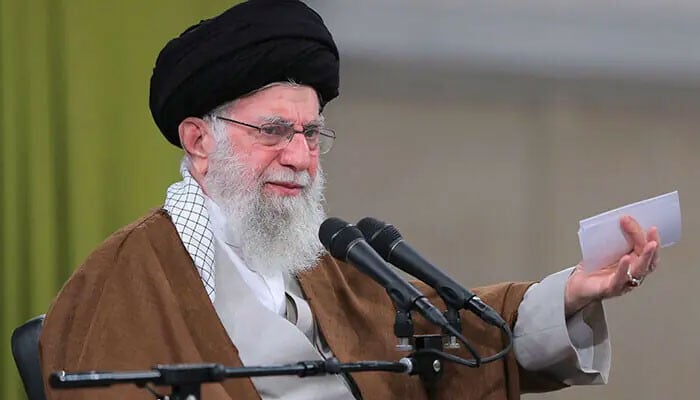
The world is in mourning as Iran’s Supreme Leader Ayatollah Ali Khamenei passed away on [Date]. Khamenei, 85, was the longest-serving leader of the Islamic Republic of Iran, holding the position since 1989. He was a key figure in Iranian politics, known for his conservative views and strict adherence to Islamic principles.
Born in 1939 in the city of Mashhad, Iran, Khamenei was raised in a poor family and was the second of seven children. He studied at a local seminary in Mashhad, later moving to Najaf, Iraq, where he became a student of Ayatollah Ruhollah Khomeini, the founder of the Islamic Republic of Iran.
Khamenei’s poetry was a notable aspect of his public personality, often referencing it in his speeches and hosting poetry readings where pro-government poets would recite their verses and receive his feedback. The interest in literature among clerics is rare, and Khamenei’s interest in gardening was also notable. He became famous for holding a significant position in the centers of power in the Iranian state, serving as a Supreme Leader, who enjoyed the power of veto in any government matter, and also had the authority to elect any public office holder of his choice as a candidate.
As the head of state and commander-in-chief of the armed forces, Khamenei was widely regarded as the most powerful figure in Iran. He rarely traveled outside the country and lived a simple life in Tehran with his wife, residing in a compound in the heart of the city.
Following Khamenei’s passing, Iran has announced a seven-day mourning period and 40 days of national mourning. In the 1960s and 1970s, Khamenei participated in anti-Shah protests and was a staunch supporter of Ayatollah Khomeini, who was in exile at the time.
Khamenei spent several years in hiding and was arrested multiple times, suffering physical abuse at the hands of the Shah’s secret police. After the 1979 revolution, Khamenei was appointed as a member of the Islamic Revolutionary Council, which oversaw the administration of the revolution.
In 1981, he was elected as the President of the Islamic Republic of Iran with 95% of the vote, just two months after surviving an assassination attempt that left him severely injured and paralyzed his left arm. During the Iran-Iraq War, Khamenei also led the Revolutionary Guard Corps.
After Khomeini’s death in 1989, Khamenei became the Supreme Leader, appointed by the Assembly of Experts, an 88-member body of Islamic scholars. His duties included not only serving as a spiritual leader but also advising on the direction of the government, commanding the armed forces, and appointing the head of the judiciary.
During his tenure, Khamenei formed a network of opposition groups, often referred to as the “axis of resistance,” which included Hezbollah in Lebanon, the Houthis in Yemen, and the Assad government in Syria. However, this axis began to unravel in 2023 after a Hamas attack on Israel, which Israel responded to by destroying Hezbollah’s leadership and toppling the Assad government in December 2024.
Khamenei also accelerated Iran’s nuclear program, leading to a decades-long standoff with the United States and Israel. After the US withdrew from the 2015 nuclear deal in 2018, Iran enriched uranium to levels close to those needed for nuclear weapons.
Domestically, Khamenei faced widespread protests in 1997, 2009, 2019, and 2022, triggered by economic hardship, political repression, and the death of Mahsa Amini. The protests were violently suppressed by security forces.
In December 2025, Iran was hit by severe economic protests, which called for the end of the Islamic Republic. Iranian President Ebrahim Raisi said that Khamenei’s death would be remembered for centuries to come.
The Revolutionary Guard Corps of Iran claimed to have targeted the American aircraft carrier Abraham Lincoln with four ballistic missiles in the Gulf. China condemned the killing of Iran’s Supreme Leader as a “serious violation of the country’s sovereignty and security.”
The PLO Secretary-General, Hussein Al-Araj, expressed his deepest condolences to the Iranian people and
