

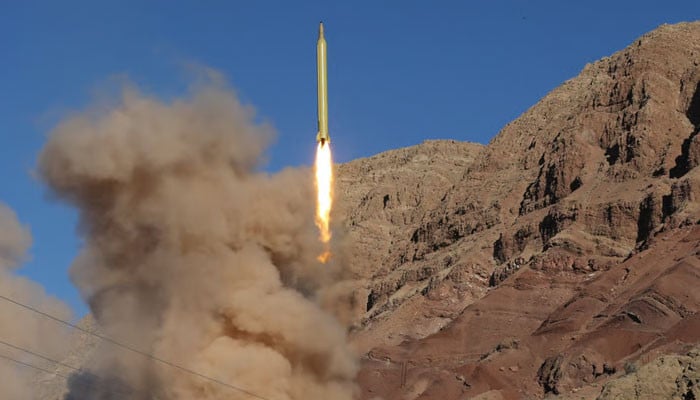
Iran has embarked on a new era of nuclear talks with the US in Geneva, with a significant focus on its ballistic missile stockpile. Here’s a closer look at Iran’s missile capabilities and range. A ballistic missile is a type of missile that can fly towards its target on the surface of the earth, and it can carry conventional, biological, chemical, or nuclear warheads. There are several types of ballistic missiles, including short-range, medium-range, intermediate-range, and intercontinental ballistic missiles.
Western powers believe that Iran’s ballistic missiles pose a threat to regional stability and could potentially be used to deliver nuclear weapons. According to the US National Intelligence Office, Iran has the largest stockpile of ballistic missiles in the Middle East, with a self-imposed limit of 2,000 kilometers. An Arab diplomat claims that Iran has presented a proposed draft of the agreement to the US.
Iranian officials claim that their ballistic missiles are sufficient for the country’s defense, as they can reach as far as Israel. The majority of Iran’s missile stockpile is located in and around Tehran, with at least five other cities across the country also said to have missiles, including Kermanshah and Sistan-Baluchestan.
According to the Center for Strategic and International Studies, Iran has several missiles with ranges of over 2,000 kilometers, which can reach as far as Israel. These include the Sejjil missile with a range of 2,500 kilometers, the Emad missile with a range of 1,700 kilometers, the Ghadr missile with a range of 2,000 kilometers, the Shahab 3 missile with a range of 1,300 kilometers, the Khorramshahr missile with a range of 2,000 kilometers, and the Hoveyzeh missile with a range of 1,350 kilometers.
The Iranian government has claimed that its missile program is for defensive purposes only, and that the range of its missiles is sufficient to protect the country from any potential threats. However, the US and other Western powers remain concerned about the potential threat posed by Iran’s ballistic missiles.
The Iranian government has presented a proposed draft of the agreement to the US, which has been confirmed by Oman. Iranian Foreign Minister Abbas Araghchi has said that it is necessary for Afghanistan and Pakistan to resolve their differences through dialogue. Meanwhile, China has expressed its concern over the escalating tensions between Afghanistan and Pakistan.
Other news stories include:
* The US and Russia have expressed concern over the escalating tensions between Afghanistan and Pakistan.
* A new report warns that the rapid development of artificial intelligence (AI) is exacerbating cybersecurity problems, while the rate of fixing security vulnerabilities is far slower.
* Former US Secretary of State Hillary Clinton and former President Bill Clinton will testify before the US Congress today on the matter of the Epstein documents.
* Iranian Foreign Minister Abbas Araghchi has said that it is necessary for Afghanistan and Pakistan to resolve their differences through dialogue.
* The Afghan government has confirmed that it has destroyed over 74 Taliban posts and captured 18 checkpoints in a major operation.
* The Pakistani government has banned the use of drones in the country.
* The opposition alliance in Pakistan has held its first meeting with the government in an effort to resolve the country’s political crisis.
* The Taliban government in Afghanistan has confirmed that it has carried out airstrikes on Kabul, Paktia, and Kandahar provinces.
* A new report warns that the rapid development of artificial intelligence (AI) is exacerbating cybersecurity problems, while the rate of fixing security vulnerabilities is far slower.
