

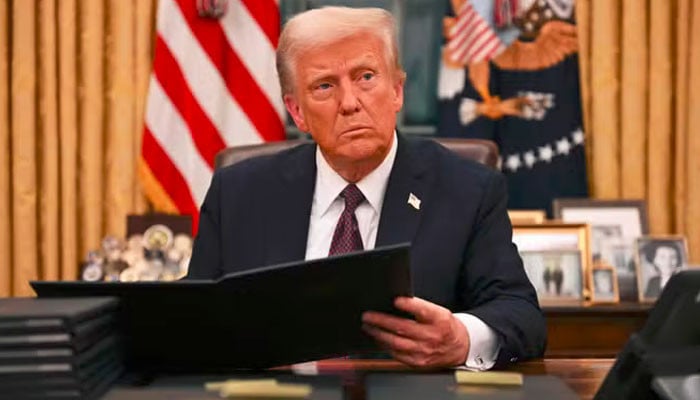
The United States has witnessed a significant escalation in the ongoing trade war, as President Donald Trump announced the imposition of a 15% global tariff on all imported goods. This move comes as a response to the previous decision of the US Supreme Court, which deemed the additional tariffs imposed by Trump on other countries as unconstitutional. Despite this setback, Trump has chosen to proceed with the imposition of the 15% tariff, leaving the international community in a state of uncertainty.
According to a statement released by the White House, the 15% tariff will be applicable on all imported goods for 150 days, with certain exceptions. The exceptions include minerals, fertilizers, metals, and energy equipment, as well as agricultural products, medicines, and their raw materials. The new tariff will not be applicable on goods imported from countries with which the US has a trade agreement, including Mexico and Canada.
This move has sparked widespread criticism and concern, with many experts and economists warning of the potential consequences of such a drastic measure. The imposition of the 15% tariff is expected to lead to a significant increase in the cost of living for American consumers, as well as a decline in the value of the US dollar.
The international community has also weighed in on the issue, with many countries expressing their opposition to the US decision. The European Union has threatened to impose retaliatory tariffs on US goods, while China has vowed to take “all necessary measures” to protect its interests.
In a related development, the US has deployed a naval fleet to the Middle East, with the Abraham Lincoln aircraft carrier already in the region. The move is seen as a show of strength and a warning to Iran, which has been at the center of the ongoing tensions.
Meanwhile, the situation in Ukraine remains volatile, with reports of a potential ceasefire agreement being negotiated between the warring parties. The agreement, which has yet to be finalized, is expected to pave the way for a peaceful resolution to the conflict.
In other news, the Pakistan Tehreek-e-Insaf (PTI) has announced that it will hold a news conference in Islamabad, where its leader and former Finance Minister, Timur Salim Jhagra, will address the media. The conference is expected to focus on the party’s stance on the ongoing economic crisis and the government’s response to it.
The PTI has also criticized the government’s handling of the economy, with Jhagra stating that the government’s claims of economic improvement are “baseless.” The party has also accused the government of prioritizing political interests over economic stability.
In a separate development, the Iranian government has expressed its opposition to the US decision to impose a 15% global tariff. The Iranian government has stated that it will not engage in negotiations with the US until the tariffs are lifted.
In sports news, the England cricket team has won the T20 World Cup, defeating Sri Lanka in the final match. The team, led by captain Eoin Morgan, has been in top form throughout the tournament, and its victory has been hailed as a significant achievement for English cricket.
As the world continues to grapple with the implications of the US decision to impose a 15% global tariff, one thing is clear: the consequences of this move will be far-reaching and unpredictable. Only time will tell how this will play out, but one thing is certain – the world is watching with bated breath.
