

From Civil Rights to the Presidential Race, Jesse Jackson’s Struggle and the Quiet Dimming of an Era
By Raja Zahid Akhtar Khanzada
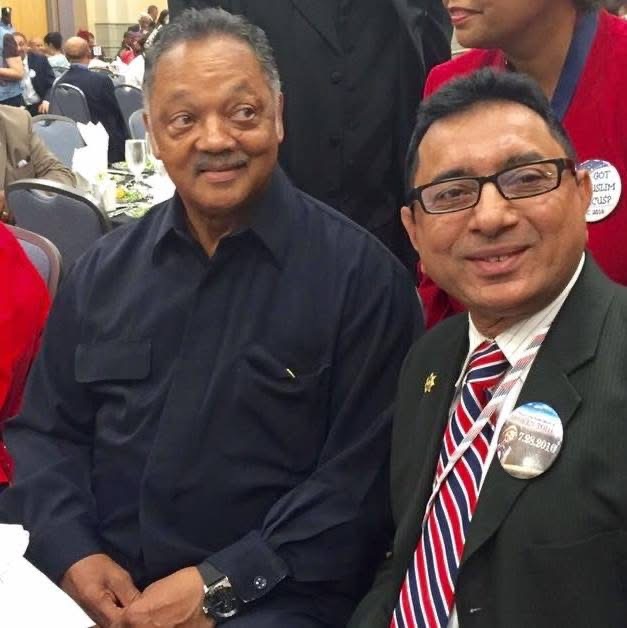
Sometimes life grants a person moments that do not remain mere photographs on the canvas of time but become the pulse of history itself. The luncheon hosted by the Muslim Democratic Caucus during the 2016 Democratic National Convention in Philadelphia was one such moment. Organized in honor of Muslim delegates from across the United States, the gathering carried the hum of civic pride and political anticipation. I found myself seated beside Rev. Jesse Louis Jackson Sr., and in the exchange of a few informal words beyond the scripted speeches, I felt as though I was conversing not simply with a man, but with an era.
The convention days were charged with political energy. Various caucuses had arranged their programs, and by evening the main stage would belong to the presidential nominee, Hillary Clinton, whose address I also witnessed firsthand. Yet during the day, inside that vast hall where political discourse echoed, cameras flashed and delegates moved in constant motion, Jesse Jackson’s presence felt like a quiet archive of American history. Here was the man who had marched alongside Dr. Martin Luther King Jr., who had raised his voice for voting rights, who had confronted corporations over their failure to include minorities, and who had opened diplomatic channels to secure the release of hostages abroad. Sitting beside him was not merely an honor; it was a moral encounter.
Jackson’s life extended far beyond the conventional boundaries of politics. Emerging from modest beginnings in South Carolina, he rose to stand within the highest circles of American power. After the assassination of Dr. King, when the civil rights movement faced uncertainty, Jackson helped carry its burden forward. He founded the Rainbow Coalition to bring African Americans, Latinos, workers, the poor and other marginalized communities into the political mainstream. His 1988 presidential campaign was not a symbolic gesture but a transformative declaration that American politics was not the inheritance of elites but the right of the people.
He compelled corporate America to embrace diversity, spoke out against apartheid in South Africa, and negotiated for the release of prisoners and hostages in Cuba, Syria and elsewhere. He received the Presidential Medal of Freedom, yet his truest distinction lay in the trust placed in him by those who had long been unheard.
The year 2016 remains vivid in memory. America stood at another electoral crossroads, and amid the charged atmosphere, Jesse Jackson seemed like an ancient tree rooted deep in the soil of history. His presence at the Muslim Democratic Caucus luncheon was not ceremonial but declarative: American Muslims were not peripheral observers but integral participants in the democratic process, their rights not favors but constitutional guarantees.
Among those present were Muslim members of Congress, including André Carson and Keith Ellison. From Dallas came the late Congresswoman Eddie Bernice Johnson, along with Congressman Al Green, Texas Democratic Party Chairman Gilberto Hinojosa and other leaders whose participation underscored that democracy is not merely majority rule but a promise of inclusion. The event was organized by Syed Fayyaz Hussain, Amir Makhani and Aftab Siddiqui, and our team played a meaningful role in its coordination. Though political in form, the gathering carried a cultural message: the American Muslim community was not simply a voting bloc but a thinking, contributing force.
My own journey has long been intertwined with the cause of human rights. In Pakistan, I was affiliated with the Human Rights Commission of Pakistan, striving to write truth under the shadow of authoritarianism. After moving to the United States, I worked with Amnesty International and now serve on the board of South Asia Democracy Watch. These have never been titles to me but responsibilities.
I also recall the profound moment when I had the opportunity to meet and interview Dr. Martin Luther King Jr. in Dallas. History is never linear; it is a dialogue across generations. Jesse Jackson was a luminous link in that continuum.
His advocacy did not stop at African American rights. When controversy erupted in 2010 over the proposed Islamic center near Ground Zero, he defended religious liberty as a foundational American principle. In 2011, at a CAIR-Chicago gathering, he affirmed that justice must rise above religious distinctions. In 2015, when proposals surfaced calling for special identification cards for Muslims and rhetoric against refugees intensified, Jackson stood with hundreds of Muslims in suburban Chicago protesting Islamophobia. He warned that singling out one faith threatened the very foundations of democracy.
In 1984, his appearance alongside Nation of Islam leader Louis Farrakhan signaled his belief in dialogue, even amid criticism. His philosophy was not confrontation but bridge-building. He understood that American society could only be whole when Arabs, Muslims, African Americans, Latinos and white Americans stood equally beneath the same democratic roof. He used his platform as a moral pulpit, speaking against Islamophobia, advocating interfaith harmony and reminding Muslim Americans that they were part of the nation’s future, not its margins.
For Jesse Jackson, human rights were never confined to one race or one people. They were the inherent right of every individual living under the shadow of fear. That is why his presence felt less like a political stature and more like a moral metaphor.
The photograph from that Philadelphia luncheon remains for me more than a keepsake; it is the marker of an era. It captures a moment beside a man who not only witnessed history but sought to bend it toward justice.
Perhaps that is journalism’s deepest purpose: to preserve such moments so that future generations may know there were individuals who spoke truth to power, and there were pens that bore witness.
And today, as news of his passing spreads across the world, it feels as though an era has quietly taken its leave. Rev. Jesse Jackson is no longer among us, yet his voice, his struggle and his moral courage endure in the pages of history. The world has lost another champion of human rights, a voice that rose for the vulnerable, a face that refused to bow before injustice. But perhaps true leaders never truly die. They arrive, they struggle, and they depart having entrusted their mission to the generations that follow.
