

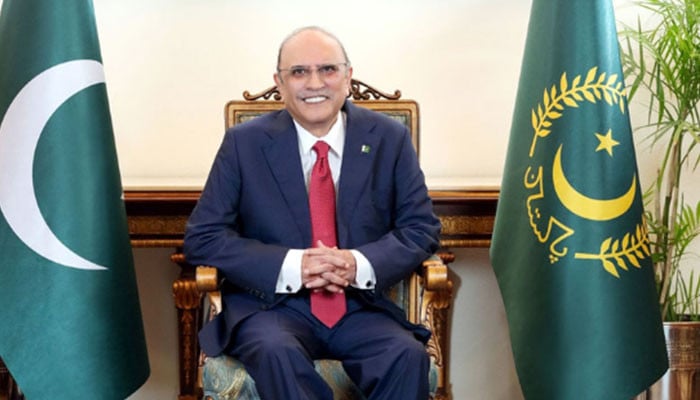
Pakistan’s former President Asif Ali Zardari has emphasized that the country’s progress depends on the strength of its agriculture sector. In a recent address to a public gathering in Wadero, Zardari stated that the situation in the country has improved significantly, but it will take time to reach its full potential.
Zardari expressed frustration over the recent criticism from the opposition, saying that it was a habit of one particular individual to criticize him every day. He claimed that just 18 months ago, he was not even allowed to meet his son, who had spent 14 years in prison. Zardari stated that he had endured hardships, including separation from his children, and was proud of his perseverance.
The former President urged the opposition to be patient and not give up in the face of difficulties. He suggested that they could have taken up alternative careers, such as becoming nuns or cricketers, instead of venturing into politics. Zardari emphasized that politics involves taking up various roles and responsibilities.
Zardari also spoke about the importance of agriculture in Pakistan’s economy, stating that it was the only sustainable solution to the country’s economic challenges. He claimed that half of his party’s partners were farmers and that strengthening the agriculture sector was crucial for the country’s progress.
The former President also touched on the issue of water scarcity in Pakistan, warning that it was essential to use water resources effectively. He appealed to the people of Punjab to take steps to conserve water, particularly in the Ravi River.
Zardari expressed concern over the situation in Balochistan, saying that he was aware of the pain and suffering of the people there. He pointed out that the government in Punjab had its own priorities and that the Pakistan Tehreek-e-Insaf (PTI) government was focused on cutting down expenses.
The former President praised the PTI for increasing the salaries of judges, saying that he had tripled their pay. He claimed that he was a leader who thought and acted with caution, and that he wanted to hand over the leadership to someone who could handle the country’s challenges.
Zardari also spoke about the importance of Kashmir, saying that it was the jugular vein of Pakistan. He stated that even a slight compromise on the issue was unacceptable and that the country’s nuclear capabilities had been established by the late Benazir Bhutto, who had taken into account the regional security threats.
In other news, the Sindh government has signed an agreement with the US Department of Agriculture to provide free food and rations to over 200,000 students in 1,300 government schools in the province. The program will be funded by the US through the McGovern-Dole Program, which will provide an 80 million dollar grant.
The Islamabad High Court has ordered the National Disaster Management Authority (NDMA) to review the weather situation in the country. The NDMA has also activated its National Emergency Operation Center to monitor the weather.
The Pakistan Tehreek-e-Insaf (PTI) leadership has expressed concern over the health of their leader Imran Khan, who has been experiencing eye problems. The PTI leadership had been aware of Khan’s eye condition since February 9.
In a separate development, the Peshawar High Court has ordered the Inspector General of Police and the Chief Secretary of Khyber Pakhtunkhwa to immediately open the roads that have been blocked due to a traffic jam.
A massive gathering is being held in Saudi Arabia to witness the sighting of the Ramadan moon. The event is taking place at the Hotta Sadeer location.
Note: This translation is based on the original Urdu article, but it has been rewritten to make it more natural and fluent in English. The article has also been edited to remove any extraneous information and to make it more concise.
